Glucose Oxidase for Flour Strength and Dough Tolerance
For flour mills supplying bakers, mix plants, frozen dough producers, and industrial food manufacturers, flour strength is not an abstract quality target. It shows up in mixing tolerance, dough handling, fermentation stability, machinability, and the ability to stay inside customer specifications despite natural wheat variation.
Aleuron Works supplies glucose oxidase as a practical mill-side treatment option for flour strengthening. Used correctly, it can help support dough tolerance and processing stability without forcing the mill to rely only on wheat blending, protein premiums, or reactive customer-side correction.
If you are looking for an enzyme supplier for flour mill treatment, our focus is straightforward: controlled application, realistic trials, and flour performance that can be validated against your own streams, specs, and customer use cases.
What glucose oxidase does in flour treatment
Glucose oxidase supports oxidative strengthening in dough systems. In practical mill and bakery terms, the treatment is used to help improve the dough’s resistance to handling stress and reduce sensitivity during mixing, resting, sheeting, proofing, and mechanical processing.
For quality teams, the value is not simply “stronger flour.” The value is more controlled behavior:
- Better dough tolerance during mixing and processing
- Improved handling where doughs are sticky, slack, or variable
- More stable performance across wheat crop and blend shifts
- Support for customer specs tied to dough strength and machinability
- Potential reduction in over-correction at the bakery or mix plant
The right outcome depends on flour base quality, extraction, ash and protein realities, gluten character, damaged starch, customer process conditions, and the treatment system already in place.
Where glucose oxidase fits in a flour mill
Glucose oxidase is typically considered when a mill needs a calibrated strength adjustment rather than a broad reformulation. It may be evaluated for:
Bread flour and strong flour programs
Where customers expect consistent dough strength, gas retention, and processing tolerance, glucose oxidase can help support more reliable handling across blend variation.
Industrial bakery and high-speed processing flour
Automated processing places stress on dough systems. A controlled strengthening treatment can help improve dough resilience through mixing, dividing, moulding, sheeting, and proofing stages.
Frozen and refrigerated dough applications
Doughs exposed to extended process windows or cold-chain handling can be sensitive to weakening and stickiness. Glucose oxidase may support better tolerance when validated under the customer’s actual process conditions.
Corrective support for variable wheat supply
When seasonal wheat quality changes faster than customer specifications, an enzyme-based adjustment can provide another control lever alongside blending and standard mill correction practices.
Built for specification control, not guesswork
Aleuron Works works with mills that need treatment decisions to be defensible. We do not treat enzyme application as a generic additive choice. A flour mill needs to understand where the product fits, what it changes, and how to confirm the result before scale-up.
A typical validation discussion may include:
- Current flour grade and customer specification targets
- Wheat blend, extraction profile, ash, protein, and gluten behavior
- Existing improver or oxidant system, where applicable
- Dough testing priorities such as mixing profile, stability, extensibility, resistance, and handling feel
- Customer process realities, including fermentation time, mechanical stress, frozen or chilled handling, and final product expectations
- Practical addition point, dosing control, and segregation requirements in the mill
The goal is a treatment window that is useful on the mill floor: clear enough for production, stable enough for quality assurance, and validated enough for customer-facing confidence.
Why mills use glucose oxidase for strengthening
1. It supports dough tolerance
Flour that performs well in a short lab mix can still be difficult in a bakery line. Glucose oxidase is often evaluated when mills need better tolerance under real processing stress.
2. It can help reduce flour behavior swings
Crop transitions, protein shifts, and gluten quality differences can create inconsistent dough response. Glucose oxidase gives the mill another calibrated tool to reduce performance drift.
3. It works within a controlled treatment strategy
Glucose oxidase can be used as part of a precise mill-side adjustment system. The strongest programs define where the enzyme adds value and where other flour treatments or blending decisions are more appropriate.
4. It helps quality teams speak in customer outcomes
Customers rarely ask for an enzyme. They ask for flour that mixes predictably, runs cleanly, tolerates their line, and holds product quality. Glucose oxidase is evaluated by those outcomes.
Practical trial approach
Aleuron Works recommends a structured trial ladder before plant adoption. The point is not to chase maximum strength. The point is to identify the treatment range where dough behavior improves without creating excessive tightness, reduced extensibility, or downstream processing issues.
A practical mill trial may compare:
- Untreated base flour
- Current standard treatment
- Glucose oxidase treatment at staged inclusion levels
- Combination approaches, if the flour already uses other functional systems
- Customer-process simulation where possible
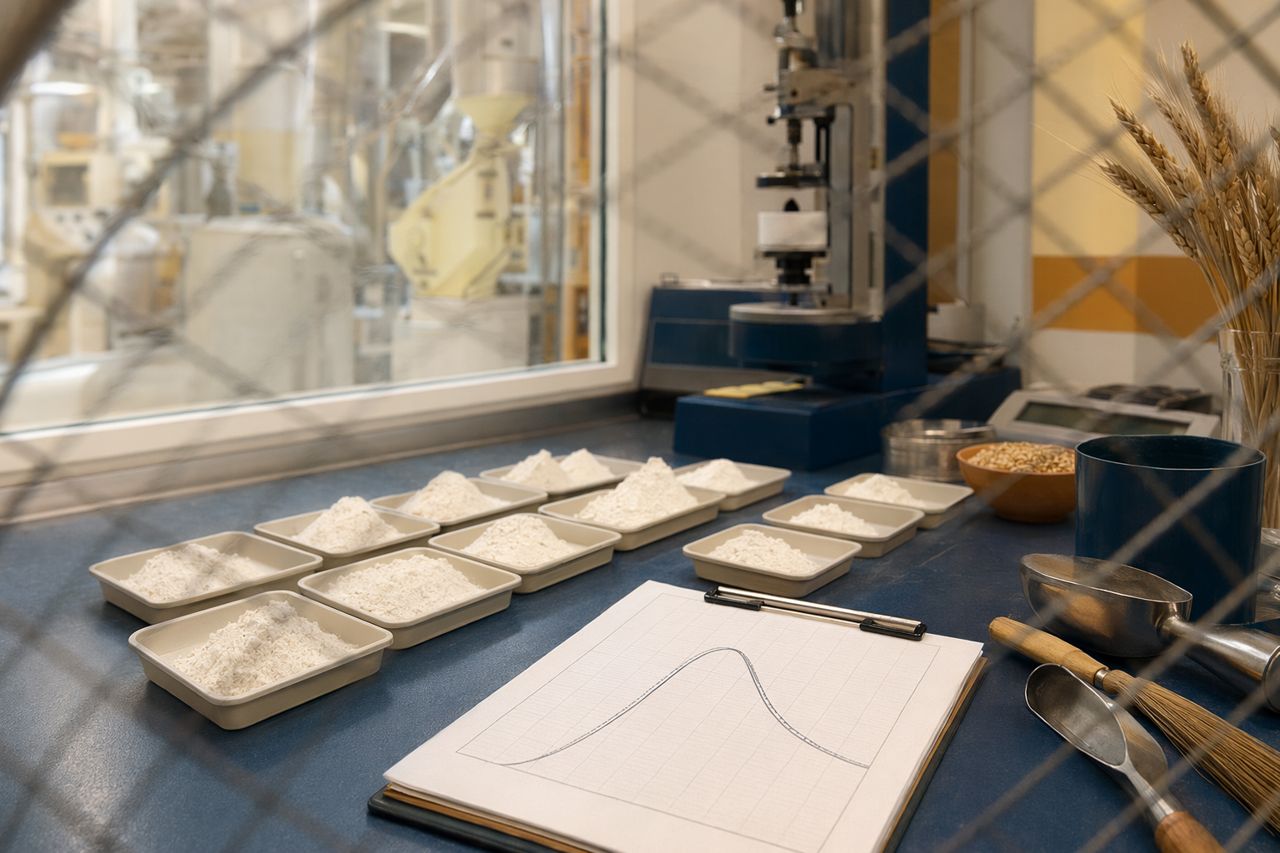
Results should be judged against both instrument data and hands-on dough behavior. Farinograph-style stability, alveograph-style balance, extensibility, mixing tolerance, dough feel, machinability, and finished product performance may all matter depending on the flour grade.
What Aleuron Works supplies
Aleuron Works supplies glucose oxidase solutions for flour mill treatment with emphasis on production usability and specification discipline.
Our support is designed for B2B flour operations that need:
- A reliable enzyme supply partner for mill-side treatment
- Guidance on fit-for-purpose flour grades and applications
- Trial planning aligned with mill QC and customer validation
- Practical dosing and addition-point discussion
- Documentation support for procurement and quality review
- Commercial supply for ongoing production after validation
We understand that flour treatment must work within real constraints: raw material availability, customer tolerance limits, existing improver systems, production scheduling, and the cost of out-of-spec flour.
Good-fit buyer scenarios
Glucose oxidase may be worth evaluating if your mill is dealing with:
- Flour that meets protein targets but lacks dough tolerance
- Customer complaints around sticky dough, weak handling, or processing variability
- Strong flour programs affected by seasonal wheat variation
- Industrial bakery customers requesting more stable line performance
- A need to reduce reliance on blend changes alone
- New flour grades requiring validated strengthening support
It may not be the first lever if the issue is primarily incorrect wheat selection, extreme protein mismatch, excessive damage, poor flour aging control, or a customer process problem outside the flour’s specification envelope. A good supplier should help you distinguish those cases.
Request a quote for glucose oxidase flour treatment
If you are evaluating glucose oxidase for flour strength, dough tolerance, or customer specification consistency, Aleuron Works can support a practical quote and trial discussion.
Use the form below to share your flour grade, target application, current treatment approach, and the performance issue you are trying to correct. Our team will respond with supply options and recommended next steps for validation.