Bread Flour vs Noodle Flour: Why the Same Wheat Blend Can Need Different Treatment Logic
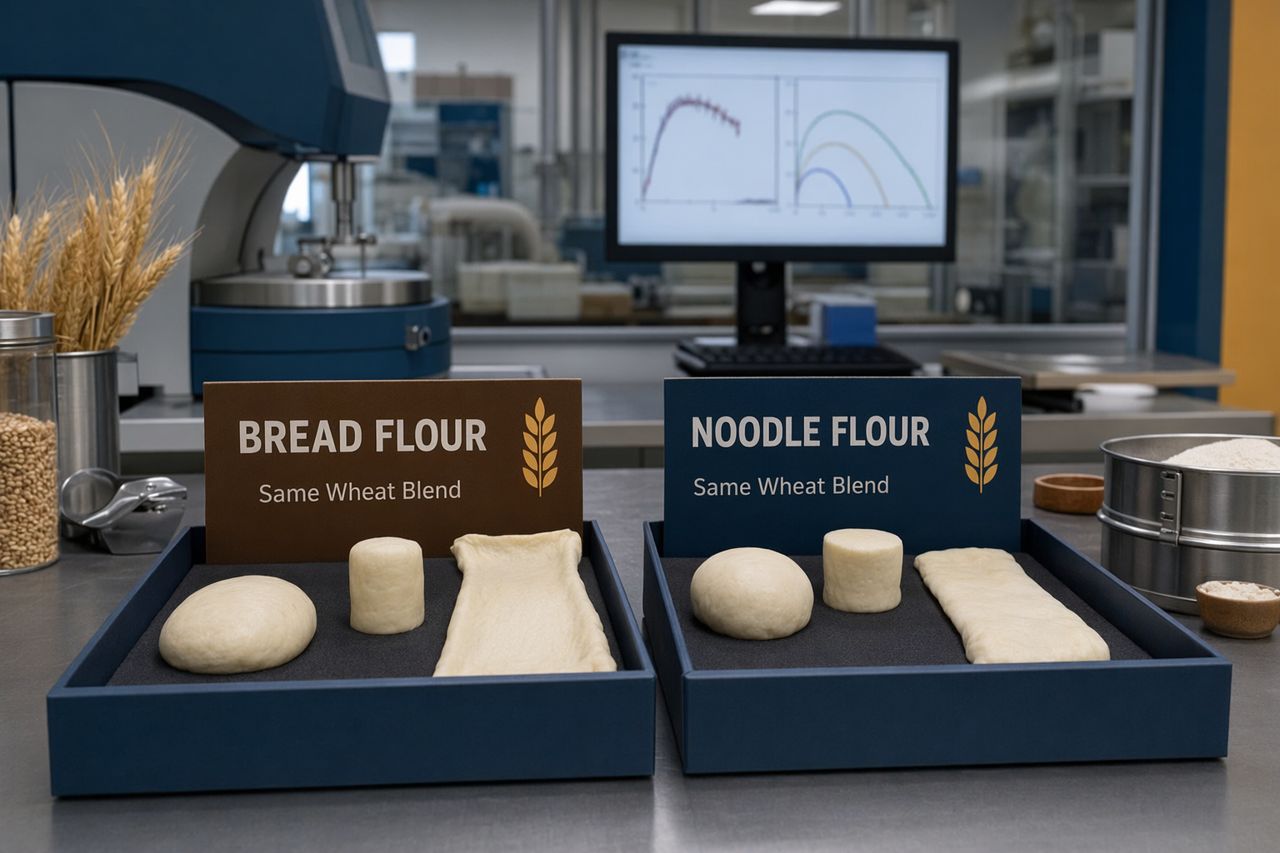
A wheat blend is not a treatment strategy. For many mills, the same incoming grist can be routed into bread flour, noodle flour, or multi-purpose customer programs depending on extraction, ash target, protein band, and sales commitments. The grain may be similar. The treatment logic should not be.
Bread flour and noodle flour ask the flour to behave differently under stress. Bread systems reward controlled gas retention, fermentation tolerance, and oven spring. Noodle systems often reward sheetability, bite, surface smoothness, color stability, and predictable hydration during mixing and resting. A treatment package that improves one outcome can easily push the other outside the customer’s preferred handling window.
For a quality manager evaluating an enzyme supplier for flour mill treatment, the practical question is not, “Which enzyme improves flour?” It is, “Which adjustment supports this flour’s end use without disturbing the customer’s specification?”
The same wheat blend carries different risks by application
A common assumption is that protein drives the decision. Protein matters, but it does not explain the whole system. Two flours with the same protein band can show different dough behavior because of:
- damaged starch level from milling intensity
- ash and bran contamination at the extraction target
- native enzyme background from crop and storage history
- gluten quality, not just gluten quantity
- particle size distribution and hydration rate
- customer process conditions, including mixer type, resting time, sheeting stress, fermentation time, and line speed
In bread flour, the mill may need to support volume, crumb structure, fermentation stability, and dough strength. In noodle flour, the mill may need to protect sheet integrity, reduce stickiness, maintain a clean bite, and avoid changes that make the dough too elastic or too slack.
That is why treatment should be built around end-use behavior, not just flour lab values.
Bread flour treatment logic: tolerance, volume, and gas retention
Bread flour must survive mixing, fermentation, makeup, proofing, and oven expansion. Even when the customer’s protein range is met, the dough can still fail if it lacks extensibility, loses strength too quickly, or cannot hold gas consistently.
What the mill is typically trying to protect
Bread customers usually notice variation in ways that are commercially visible:
- loaf volume drifting between flour lots
- dough that feels tight one week and slack the next
- proof tolerance changing after storage
- crumb becoming coarse, weak, or uneven
- reduced machinability on high-throughput lines
- complaints that the flour is “within spec” but not behaving the same
For bread flour, enzyme treatment often focuses on balancing dough handling with fermentation performance. The goal is not to make the flour aggressively active. The goal is to make the flour more dependable inside the baker’s process window.
Where treatment can help
A calibrated treatment approach may support:
- more consistent gas availability during fermentation
- improved dough handling without excessive softness
- better loaf volume and crumb resilience
- reduced lot-to-lot performance variation
- improved tolerance where wheat quality is variable
But the dosage window matters. Too much relaxation can reduce dough strength. Too much fermentable support can alter proof behavior. A bread flour treatment plan should be validated against the specific customer’s process, not only against a generic baking test.
Noodle flour treatment logic: sheetability, bite, color, and surface quality
Noodle flour has a different performance language. The customer is not usually asking for oven spring. They are asking for dough sheets that run cleanly, strands that hold form, texture that matches the eating profile, and color that remains acceptable through the process.
What the mill is typically trying to protect
Noodle flour variation may show up as:
- sheeting cracks or ragged edges
- sticky dough during reduction rolls
- uneven hydration after resting
- finished noodles that are too soft, too elastic, or too brittle
- color drift or speck visibility concerns
- bite profile changing from lot to lot
These outcomes are influenced by protein quality, starch behavior, ash level, and milling granulation. The treatment decision must respect the noodle style: fresh, dried, instant, alkaline, steamed, or regional specialty noodles can each require a different balance.
Where treatment can help
For noodle flour, enzyme treatment may be used to influence:
- hydration behavior and processing tolerance
- sheet smoothness and dough extensibility
- texture consistency after cooking or steaming
- surface quality and reduced handling defects
- stability when wheat lots change within the same specification band
The risk is overcorrection. A treatment that makes bread dough more forgiving may make noodle dough too relaxed. A flour that performs well in pan bread may lose the snap, bite, or sheet strength a noodle customer expects.
Why ash and protein realities matter
Mills do not treat flour in a vacuum. They treat flour inside extraction economics and raw material constraints.
A higher extraction target may improve yield but introduce more bran influence, higher ash, and greater impact on color or dough behavior. A lower ash stream may be cleaner but may not always deliver the protein or functionality required by the customer. Protein targets can also become complicated when crop quality shifts, supplier origins change, or storage lots are blended to control cost.
The right treatment logic accepts these realities. It asks:
- What performance gap remains after blending and milling adjustments?
- Is the gap related to strength, extensibility, hydration, fermentation, texture, or color?
- Which customers are most sensitive to this change?
- What is the safe dosage range before another attribute is disturbed?
- How will the mill verify performance before release?
This is where an operations-aware enzyme supplier adds value: by helping the mill connect flour analytics, bench testing, customer process requirements, and controlled plant trials.
A practical comparison: bread flour vs noodle flour treatment decisions
| Decision point | Bread flour logic | Noodle flour logic |
|---|---|---|
| Primary performance target | Gas retention, volume, fermentation tolerance, crumb structure | Sheetability, bite, surface smoothness, cooking or steaming texture |
| Main customer complaint when treatment is wrong | Dough weakens, volume drops, proof behavior changes | Dough sticks, sheets crack, texture shifts, color or surface defects appear |
| Common risk from over-treatment | Loss of strength, excessive softness, unstable proof response | Over-relaxation, poor sheet strength, texture outside target |
| Validation emphasis | Bake performance, dough handling, tolerance through fermentation | Mixing, resting, sheeting, cutting, cooking or steaming response |
| Mill-floor priority | Stable performance across wheat variation | Consistent processing behavior and eating quality |
The point is not that one flour is more difficult than the other. The point is that each flour has its own failure modes.
Build treatment from the customer’s process backward
Aleuron Works approaches flour mill treatment as a controlled adjustment, not a generic additive selection. The best program usually starts with the customer’s performance requirement and works backward through the flour system.
Step 1: Define the commercial target
For bread flour, this may be loaf volume stability, mixing tolerance, crumb resilience, or reduced complaints from industrial bakeries. For noodle flour, it may be sheeting reliability, bite profile, lower stickiness, or color and surface consistency.
Step 2: Map the flour reality
Review the flour’s protein band, ash target, damaged starch tendency, granulation, wet gluten behavior, and historical lot variation. Treatment should complement milling and blending decisions, not hide an unstable process.
Step 3: Select a narrow treatment direction
A focused adjustment is easier to validate than a broad, aggressive package. In many mills, the most effective program is the one that solves the specific handling gap without creating a new customer complaint.
Step 4: Trial through relevant application tests
Bread flour should be assessed in the bread system that matters to the customer. Noodle flour should be assessed through the noodle process that matters to the customer. A flour can look promising in one format and fail in another.
Step 5: Confirm dosage control at mill scale
Mill-scale success depends on controlled addition, blending consistency, operator clarity, and defined checks before product release. A good treatment plan must be practical for the mill floor, not just convincing in a lab discussion.
When the same blend should not receive the same treatment
A single wheat blend may support both bread flour and noodle flour programs, but treatment should split when:
- bread customers need more fermentation tolerance while noodle customers require firm bite
- noodle flour requires clean sheeting but bread flour needs more extensibility
- ash or color limits are tighter in one product stream
- customer processing conditions differ significantly
- the same dosage creates acceptable lab numbers but different application outcomes
- complaint history shows different failure modes by customer segment
This is especially important for mills supplying multiple industrial customers. The flour may share a raw material base, but the customer’s process defines whether the treatment is correct.
What quality managers should ask before approving a treatment package
Before approving an enzyme treatment for bread or noodle flour, a quality manager should be able to answer:
- Which specific customer performance issue are we solving?
- Is this issue consistent across lots, or linked to a particular wheat origin or extraction level?
- What application test will prove improvement?
- What attribute must not change?
- How narrow is the working dosage range?
- How will production control addition and blending?
- What release checks will detect drift before the customer does?
If these questions are unclear, the treatment logic is not ready for routine production.
Aleuron Works perspective
Bread flour and noodle flour are not just two labels on the same milling stream. They are two different performance contracts with the customer.
Aleuron Works supports flour mills with enzyme treatment programs built around application behavior, dosage discipline, and trial validation. We help mills evaluate where enzyme treatment can stabilize performance, where milling or blending should come first, and where a separate treatment logic is needed for different flour lines.
If you are comparing treatment options for bread flour, noodle flour, or a shared wheat blend feeding multiple product specifications, our team can help you structure a practical evaluation.
Request a quote
Need a treatment program matched to your flour specification and customer process? Use the on-site request a quote form to share your flour type, target application, current performance issue, and trial requirements. Aleuron Works will respond with a practical recommendation pathway for review.